

Frequently asked questions

What is a complimentary consultation call?
Our 20-minute phone consultation is an opportunity for us to share information and see if we are a good fit. You can share a brief overview of why you are seeking therapy, and we can discuss your situation, goals, and any questions you have about how I work. This conversation will give you a sense of my style and what it will be like talking with me. There is no obligation to schedule a session. If either of us feels I am not the right therapist for your unique path, I am happy to provide trusted referrals to other resources.
Where are you located, and do you offer virtual sessions?
I serve clients locally in the Dallas-Fort Worth Metroplex for in-person care at my office in Southlake. I also provide secure, confidential tele-health sessions to anyone physically located within the State of Texas at the time of service. My HIPAA secure client portal for virtual sessions allows you to click on a link from your email and join the video call. There is nothing to download and nothing is recorded.
How long does ‘regular’ therapy usually last?
Individual, couples, and family therapy timelines vary depending on your unique goals, the complexity of your challenges, and your preferred pace.
My pre-paid pre-marital therapy is designed for 8 sessions which gives a discount equivalent to what less than 7 sessions would cost one by one. Certainly couples may pay for the same topics and material one session at a time.
Discernment Counseling is strictly short-term. Following a complimentary 20 min. individual phone screen with each spouse and after concluding that the couple fits the requirements for Discernment Counseling, a 1-5 session weekly structure begins. A first session for this process is 2 hours, and any following session is 90 minutes. Most of the 5 sessions will be time spent individually with a few minutes spent together.
What is Discernment Counseling and how is it different from couples therapy?
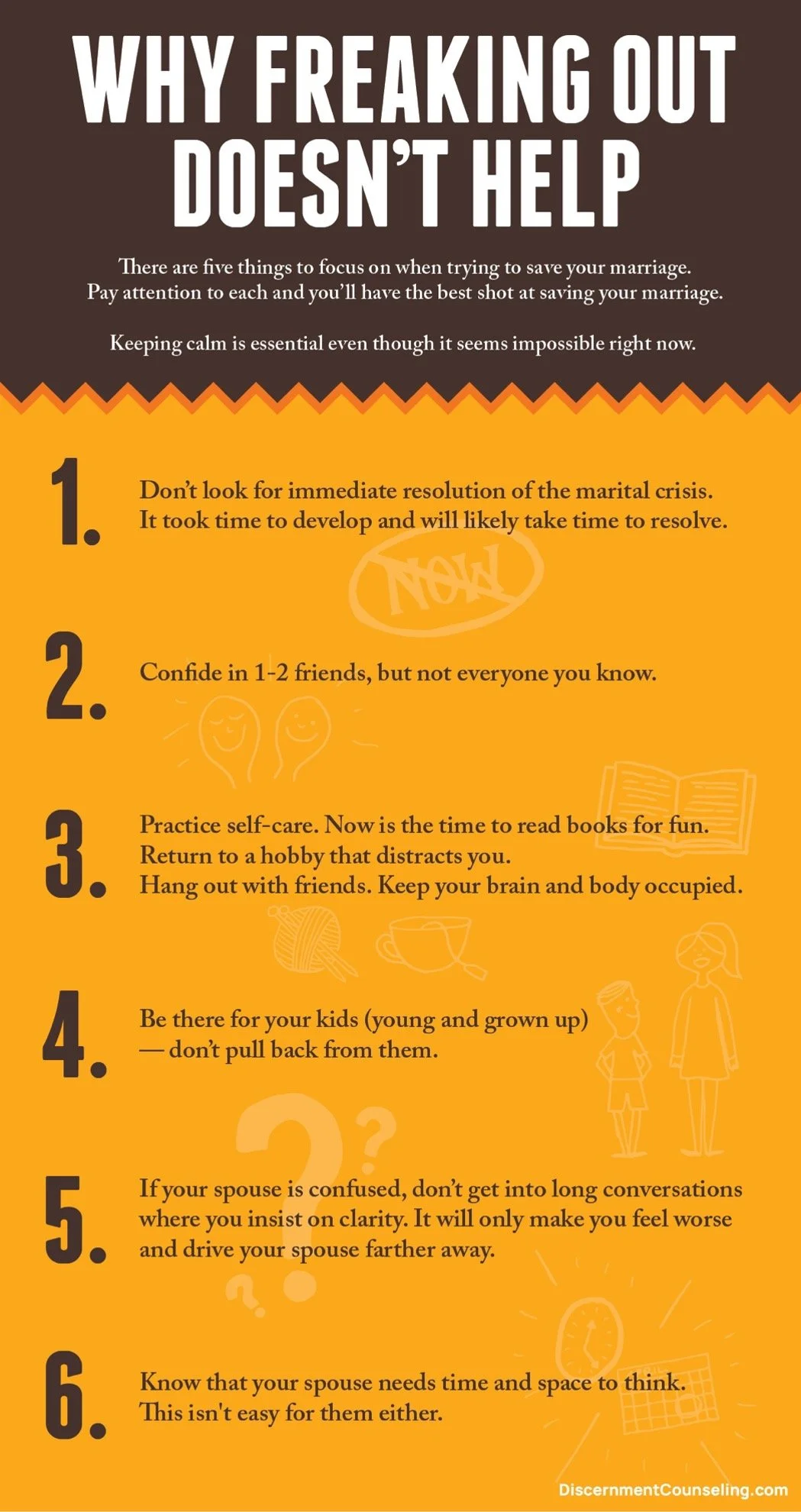
Discernment counseling is a short-term, highly-structured process (1 to 5 sessions) designed specifically for couples on the brink of divorce when one partner is leaning out of the marriage and the other is wanting to save it. The goal is simply to find clarity and confidence about whether to try to repair the relationship or transition apart with peace. In this special format, it is not about solving the issues however, that is one of the three options at the conclusion of this process.
Traditional couples therapy aims to heal the relationship and address concerns, improve communication patterns, and heal that each partner has when both partners are motivated to work on the partnership.
Are there situations where Discernment Counseling is not suitable?
Yes.
• When one spouse has already made a final decision to divorce.
• When one spouse is coercing the other to participate.
• When there is danger of domestic violence.
I want to work on my relationships, but my partner or family won't come to therapy. Can I come alone?
Yes. Individual Therapy focuses heavily on growth and relational readiness. Because the most important relationship you have is the one with yourself, we can work on personal goals which will likely shift how you interact with everyone else in your life.
Do you accept insurance?
I am an out-of-network provider and thus do not accept insurance however, you may be able to file for out-of-network benefits with your insurance company. Please check with your insurance provider to inquire about mental and behavioral health benefits. If mental health benefits are covered, I can provide a receipt (called a Superbill) for you to submit for possible partial reimbursement of your psychotherapy. If your health insurance provider requires a diagnostic code, we will discuss the code ahead of time.
Are there any questions to consider asking my insurance company if my plan includes out-of-network mental health benefits?
1. What are my outpatient benefits for psychotherapy? (Depending on your situation, inquire about individual and/or couples.)
2. Does this include tele-health benefits too?
3. Is there a deductible and has it been met?
4. What is my copay responsibility?
5. Do I need a pre-authorisation or referral from my primary doctor?
6. How many sessions do I get in a calendar year?
7. Is there anything else that would be good for me to know about for this benefit?
What is your cancellation policy?
If you are unable to attend a session, please cancel or reschedule at least 24 hours ahead of time; otherwise, you will be charged for the full rate of the session. To support you through unexpected life events, I offer one grace cancellation per calendar year inside the 24-hour window at no charge.
Do you have experience working with multicultural couples or families?
Yes. I provide specialized, culturally attuned support for first- and second-generation immigrants navigating dual cultural identities. I also work frequently with intercultural, interracial, and interfaith relationships to help partners smoothly and respectfully blend traditions. It is a personal passion to work with people whose first language is not English.
Can you help if a family member is struggling with substance use?
Yes. While I treat individuals, couples, and families, both in and out of recovery, I offer specialized support for those experiencing the unique pain and systemic chaos of a loved one's addiction. We focus heavily on breaking free from codependency and establishing healthy, distinct personal boundaries.
What does "Restructuring the Family Dynamic" actually mean?
Families shift naturally over their lifespan. This specialized path is designed to support long-term wellness and health span during major transitions. It includes adjusting to a divorce, blending families, processing a shared grief or loss, and often consciously breaking generational patterns to benefit the entire system.